
Search
-
 February 5, 2026By Tanya Connor
The Catholic Free Press
A Massachusetts novena for peace and the canonization of a European ruler, with connections to the Worcester diocese, was held Sunday at St. Paul Cathedral.
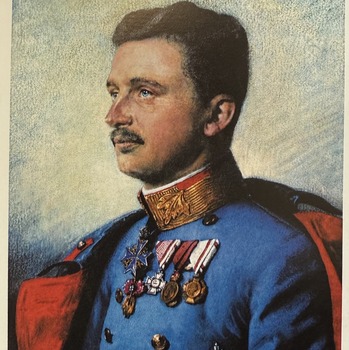
Bishop McManus celebrated Mass, the fifth in a novena of monthly Masses honoring Blessed Karl of Austria (also called Charles, of the Habsburg monarchy), Emperor of Austria and King of Hungary from 1916-1918 during World War I.
Blessed Karl “exemplified what it means to be a truly Christian and Catholic leader ... because he really led out of a great love for his country and his people,” said Paul Jernberg, a former member of the Worcester diocese who still has ties here.
“All of that love was rooted in his faith and the grace of God. ... It’s sort of a paradox, because, in the world’s eyes, he was a failure, because he was exiled ... and died ... in his 30s and left his wife” and several children. But he was a model for today’s leaders.
William Claeys, a junior at St. Thomas Aquinas College in Northfield, who grew up in Virginia, said he initiated the novena of Masses, being celebrated throughout Massachusetts, with plans to expand to other states next year.
Father Alfredo R. Porras, director of the Worcester diocese’s Office for Divine Worship, helped him organize the Mass at St. Paul Cathedral, the first celebrated by a bishop, he said.
Mr. Claeys met Father Porras at a conference about Blessed Karl in Washington, D.C., in October 2024.
Mr. Jernberg said he initiated that conference and composed music for a Mass in honor of Blessed Karl, and Father Porras used it in celebrating Masses for the conference.
Father Porras has also celebrated other Masses organized by Magnificat Institute of Sacred Music, which Mr. Jernberg founded in the Worcester diocese in 2017 and, in 2022, brought to Wyoming, where he is now music director at Wyoming Catholic College. He returns to his former parish, St. John, Guardian of Our Lady Parish in Clinton, to record the Institute’s music.
At Sunday’s 10 a.m. Mass at St. Paul Cathedral, Bishop McManus preached about Blessed Karl and prayed the novena’s Day 5 prayer. Mr. Claeys read the Day 5 reflection and, after Mass, offered prayer cards to attendees, who seemed to appreciate the opportunity to learn about Blessed Karl that day.
This last emperor of the Austro-Hungarian Empire ruled during the First World War, and was exiled to Switzerland, then Portugal, where he died on April 1, 1922, Bishop McManus noted.
He called the Beatitudes in the day’s Gospel a way to become a saint, reiterated Jesus’ words about peacemakers, and said Blessed Karl worked for peace.
He noted that the emperor’s Catholic faith influenced his personal and political life, he was dedicated to prayer and the Blessed Mother, and that he reportedly said his primary vocation was to help others achieve salvation.
In 1911, Blessed Karl married Princess Zita (proclaimed Servant of God by Pope Benedict XVI) and they raised their children in the faith.
Bishop McManus recalled a connection between the family and the Worcester diocese: after Blessed Karl died, Princess Zita came to Royalston, where she attended local Masses.
During World War II Empress Zita and her family were given refuge in a home in Royalston, according to a March 15, 2020 Athol Daily News article. It included memories of Royalston resident Alan Bowers, who said that around 1940 the empress moved to Quebec, but the family returned to Royalston in the summers.
In an Oct. 21, 2005 article about Our Lady Immaculate Parish in Athol, which served Royalston, The Catholic Free Press recounted a priest saying that Empress Zita worshipped there, and that she had fled Austria because of Hitler.
Bishop McManus said Sunday that today the world suffers from war and discord that creates insecurity and fear, and needs leaders who seek peace and justice over threats and actions of destruction.
The novena prayer recalled Blessed Karl’s living of his faith, and asked for his canonization and for God’s help to forgive “injustices done against me.” The reflection spoke of Blessed Karl not fearing personal danger and trying to end the war quickly.
“It is hard to believe that a man with such virtues and noble character could be so bitterly opposed,” the reflection said. “Sacred Scripture teaches that the standard of holiness can be measured by one’s capacity to love your enemy. In light of this criterion we can grant that Blessed Karl had a high degree of virtue.”
Mr. Claeys told The Catholic Free Press about organizing the novena for Blessed Karl, whom he learned about through a talk in 2019. In 2024, he joined the Gebetsliga, a prayer league promoting Blessed Karl’s canonization.
The website emperorcharles.org/what-is-the-gebetsliga says: When Karl was a child, “a Hungarian stigmatist nun named Mother Vinzentia Fauland prophesied that the young archduke should be enveloped in prayer because he would become emperor, suffer greatly, and become a target of hell. A small group was formed to pray for him and his intentions throughout his life.” After his death, “the group promoted him as a heavenly intercessor and advocate for peace.”
Mr. Claeys said he was brainstorming how to bring devotion to Blessed Karl to Massachusetts.
“I think there’s a lot of turmoil in our country and our world,” the student said. “I think we should be asking his intercession for more political rulers like him ... who see peace as the goal... I think he’s a saint for our times” because of his efforts for peace and his prioritizing of family.
“I knew that I wanted one Mass in each of the dioceses of Massachusetts” for the novena, Mr. Claeys said.
He said he visited shrines to Blessed Karl at Descent of the Holy Spirit Ukrainian Catholic Parish in South Deerfield, where the first Divine Liturgy for the novena was held Oct. 21, his feast day, last year, and St. Adelaide Parish in Peabody, where the ninth Mass is to be celebrated June 29.
The second Mass was at St. Paul Oratory in Warren Nov. 7, where the rector, Rev. Canon Pierre Dumain, of the Institute of Christ the King Sovereign Priest, wants to establish a third Blessed Karl shrine in Massachusetts, Mr. Claeys said. Canon Dumain said he would like it to be a little chapel inside the church.
Mr. Claeys said the other Masses were in Roman and Maronite Catholic churches within the Fall River diocese, and the sixth is scheduled for March 15 with St. Athanasius in Lowell.
Plans for the seventh and eighth novena Masses are to be announced on the website emperorcharles.org, Mr. Claeys said.
Speaking of being at St. Paul Cathedral he said, “I’m happy that I can introduce this to new people.”
Editor’s note – See the website emperorcharles.org for the novena and more information.