
Search
-
 May 30, 2025By Tanya Connor
The Catholic Free Press
STILL RIVER – Students at Immaculate Heart of Mary School started using a new addition to the elementary school building last month.
So did the religious sisters and brothers from the Slaves of the Immaculate Heart of Mary of St. Benedict Center who run the school and helped with the work for the addition.
Sister Katherine Maria Mueller, the sisters’ prioress, and Brother Anthony Marie Brackett, project manager, job supervisor and foreman, recently told The Catholic Free Press about the project.
There are 100 students in the building for grades 1-8, to which the new addition is attached, and 40 students in the high school across the street, Sister Katherine said. She said the goal is to increase elementary school enrollment, possibly to 200.
The addition was needed for consistency in elementary school classroom size, so each grade can have a maximum of 25 students, and those students can attend the school from grade 1 through grade 8, she said. She said there were 17 first-graders this year,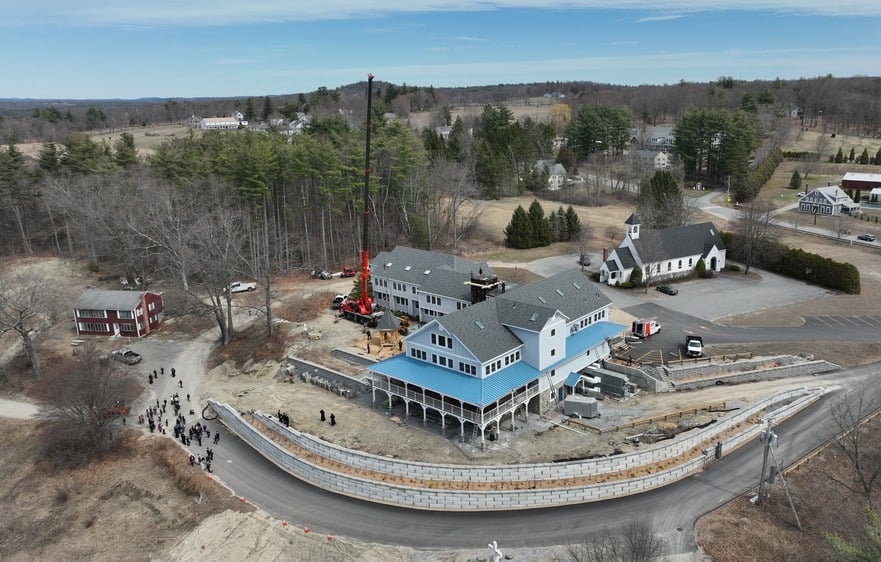 the highest number they’ve ever had for this grade. This year a wall was taken down in preparation for the new addition, which allowed for enough space. With the new addition they can accommodate more students in the future.
How are the Slaves (canonically called a public association of the faithful) building an addition to their school, when some other Catholic schools have closed over the years? What’s special about what they offer?
“A traditional Catholic environment” with classes taught by religious sisters and brothers is “unheard of nowadays,” Brother Anthony said. “And it’s affordable,” since the religious have the vocation of “giving up your life for this.” The Slaves do not get salaries, but are provided for through money they raise, including from tuition – $4,000 per year for one student in grades 1-12, cheaper for multiple family members.
The sisters and brothers also have “charming personalities,” joked Sister Katherine, not far off the mark for the friendly, outgoing religious.
“We still teach penmanship and traditional math,” including fundamentals – “a pure, Catholic education” like the older generations remember receiving themselves, she said. The Slaves still require some hand-written papers, because, with today’s artificial intelligence, students can “push a button” and get their papers written for them, which is “really crippling their education.”
“Our education is more structured” and disciplined, she said. And there is a music program, art appreciation and art education.
Brother Anthony said the school basketball team (grades 7-12) is part of the Worcester Central Athletic Conference, and the baseball and cross-country teams, which are independent, play other school teams.
The high school does not use the new addition but benefits from the overall project, which included the institution’s first athletic field, a multipurpose one which they started to use in the spring of 2024, he said.
Projects still to be completed include outdoor Stations of the Cross, and an Our Lady of Lourdes grotto.
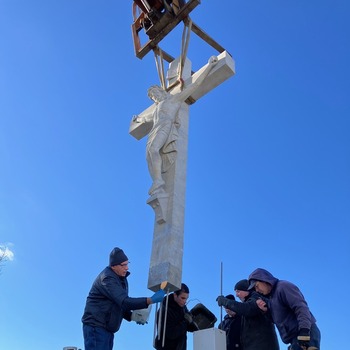
“Once you have the property, you start coming up with ideas,” Brother Anthony explained. He said they got the granite Stations of the Cross and the life-sized marble statues for the 12th Station (Jesus dies on the cross) from a closed shrine in Vermont, which told the Slaves, “If you can move them, you can have them” at no charge.
In the 1980s the Slaves bought the initial property here (about three acres) and turned the house on it into a school for grades 1-12, Brother Anthony said. In the early 1990s the brothers built an addition on it. That building is now the elementary school, to which the newest addition was just attached.
The Slaves built a chapel on that property, and expanded on property across the street, which includes the high school and gym, opened seven years ago to relieve space problems in the original school building, he said.
They couldn’t expand further on the elementary school’s side of the street because they had reached zoning limits. So, in 2017, they bought 88 acres abutting it from a neighboring farm, and in 2019 broke ground for the addition, which they are using while still finishing it, he said. He said they now own 100 acres.
The 18,000-square-foot, four-storey addition is more than double the size of the four-storey original school building, he said. There is a six-stop, double-sided elevator because of the elevation differences in the original building and the addition. Four new classrooms supplement the existing classrooms for grades 1-8. There is a new library, art room, kitchen, and a new dining room for the sisters and one for the brothers.
Sister Katherine said the former dining rooms are being turned into a first-grade classroom and a nurse’s station and the former kitchen an office, science room and kitchen for occasional hot lunches for students. The former library space will be offices and a teachers’ resource room and the art room was absorbed for the elevator system.
The brothers did the site work for the addition with heavy equipment they own, milled timbers with their sawmill and did finish work and landscaping, Brother Anthony said. They worked with the general contractor and master electrician (alumnus Luke Austin) and with those doing mechanical, electrical and plumbing installation.
Not to have the women’s contributions overlooked, Sister Katherine chimed in that the sisters painted the walls in the addition and applied stain and polyurethane to the woodwork.
“The sisters fed us,” and cleaned up the job site too, Brother Anthony added.
The work of the religious and other volunteers, including students and parents, helped save on the cost of the building. Brother Anthony said the architect’s estimated cost was $2 million, but that he didn’t know the final cost and that some work on the project is still being done.
“It was a five-year project, so you can spread out the financial load over time,” he explained.
Acquiring other people’s unwanted materials also helped cut costs.
Brother Anthony said five percent of the wood was from donated former movie sets from New England Studios in Devens.
Sister Katherine said that when some of the sisters were at a yard sale, they saw a closed bar and grill across the street, with stainless steel dumped outside – like they were seeking for their new kitchen. Upon inquiring, they learned they could take it at no charge. While collecting it, they also checked the dumpster on the property.
“Some guy was driving by and he thought [the dumpster-picking sisters] were starving and he gave them money,” Sister Katherine added, with her characteristic humor.
The Slaves have multiple apostolates to spread the faith, which end up generating money for their ministry too, Brother Anthony said. Examples include their school, youth summer camps, online and physical gift shops, and subscriptions to their quarterly magazine “From the Housetops.”
“We had to pass 12 inspections” by the town and state for the new project, Sister Katherine said. On Holy Thursday, April 17 this year, the building inspector gave them the occupancy permit. On Easter Sunday their chaplain, Father Daniel J. Becker, a Worcester diocesan priest, blessed the addition, and on April 28, the feast of St. Louis de Montfort, they had their first dinner and classes there.