
Search
-
 April 24, 2025By The Catholic Free Press
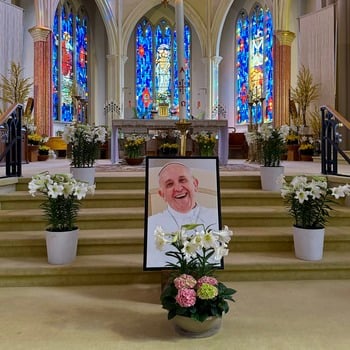
Local Catholics shared observations and memories of Pope Francis this week upon learning of his death Monday.
David Dziena commented about the pope being among the crowds on Easter: “That was kind of an encapsulation of his message to be close to the people, even the day before he died. ... It’s a model for all of us – focusing on Christ, trying to be humble and focusing on loving one another.”
Mr. Dziena, vice president of publishing of Bayard Inc., whose office is located at Assumption University in Worcester, has personal memories of Pope Francis too.
“I’m grateful to have had the opportunity to see him so close to his passing,” he said. He and his wife, Gloria Shahin, and Ted Musco, Bayard consultant for family catechesis, met with Pope Francis in January. Mr. Dziena gave the pope Bayard Jubilee Year resources, and letters and drawings from St. Joseph Elementary School in Webster.
They told Pope Francis about the materials and said, “We pray for you every day,” and the pope responded in English, “I need it,” Mr. Dziena said.
He said his wife commented that when Pope Francis is shaking your hand and looking you in the eyes his focus is just on you.
Two diocesan seminarians studying at the Pontifical North American College in Rome had the opportunity to meet Pope Francis in the summer of 2023 and offered these comments to The Catholic Free Press.
“What struck me most of all was the gentleness and humor with which Pope Francis addressed all of the seminarians. While blogs and media may portray him in differing ways, his candor and kindness are what stood out to me as I shook his hand,” said Jakob Pohlman, one of those seminarians said. “He seemed genuinely pleased and excited to meet me, almost as much as I was to meet him.”
Christopher Tillotson, said of the encounter that the pope was “very fatherly, funny, and willing to share his advice on how to navigate being a seminarian in Rome.”
In recent months, Mr. Tillotson said he prayed the rosary in St. Peter’s Square for the pope’s health when he was in the hospital and read his autobiography.
He watched Pope Francis’ final ride in the popemobile.
“I know he will be missed because on Easter Sunday when we watched him ride in the popemobile we were so happy to see him. Many were shedding tears, and I too shed a few of joy to see him again with his flock,” Mr. Tillotson said.
Father Lucas LaRoche, administrator of Sacred Heart of Jesus Parish in Webster, studied at the Pontifical North American College in Rome from 2017-2023 and met Pope Francis twice. The most recent meeting came in the fall of 2021. Father LaRoche and his classmates at the seminary had a private meeting with Pope Francis.
Father LaRoche said the only phrase that Pope Francis ever spoke to him personally was, “Thank you for not bringing me a football jersey.”
Several American seminarians had presented him with such jerseys in previous months, but Father LaRoche had no such gift.
Last fall, Pope Francis published his final encyclical on the Sacred Heart of Jesus – Dilexit nos.
“It’s impressive,” Father LaRoche said. “I do think it was his best one in some ways because we get to see him in the tradition of the great religious poets in the Spanish language, speaking about the heart of Jesus that burns for us and the whole world in a very real way.”
Father LaRoche said the impact of Pope Francis may not be fully known for another decade or so, but he believes he has already left his mark in some important ways.
“The Holy Father, as an outsider from the Roman Curia, was elected with the mandate, it seems, to clean up the mess that was the Vatican,” Father LaRoche said, “and it’s a job that’s far from done, but he’s the one who put the first big steps in that direction.”
For Mari Ann Paladino, meeting Pope Francis personally wasn’t necessary. She told about taking teenagers from her parish, St. Columba in Paxton, to see him when he visited Philadelphia in 2015. A news reporter asked one, “Do you think you will see the pope?” and the boy responded, “I don’t know ... I’m here to feel the pope.”
“It made me think,” Ms. Paladino said. “It was the feeling in the whole environment. Everyone was excited. He was different than any other pope. ... Whenever this pope spoke, you always felt him. ... He reached out to so many people on the fringes.”
“He always took a stand – in a very pastoral way,” she added. “He was not judgmental.”
Anthony Riopel was one of the St. Columba teenagers on that trip; now he’s a FOCUS missionary at Bridgewater State University.
“My brother ... and I found a ... tree,” he recalled. “There was no standing room. It was so amazing to see the pope” go by in the popemobile from the tree they climbed.
Mr. Riopel said he’s saddened by Pope Francis’ death.
“There’s a lot to learn from his time in the papacy,” he said. “He was the right pope for the right time.”
Father John F. Madden, pastor of St. John Parish in Worcester, which is home of St. John’s Food for the Poor at the St. Francis Xavier Center, recounted Pope Francis’ election on March 13, 2013, the day after St. John’s annual Novena of Grace in honor of St. Francis Xavier concluded.
“That year, in 2013, we were praying that God would send us a shepherd after his own heart,” Father Madden said, “and the day after, God did.”
Father Madden said he appreciated that Pope Francis referred to himself as the “world’s parish priest” and that he called the church a hospital for sinners, not a museum for saints.
“All those things resonate with everybody,” Father Madden said, “and I think that he lived and taught us that reaching out to the periphery in trying to help those in need, we recognize our own need and open ourselves up to God’s healing and God’s hope in our own lives.”
Msgr. Francis J. Scollen is the retired pastor and current sacramental minister at St. Peter Parish and St. Andrew the Apostle Mission. He oversaw the St. Peter’s Food Pantry for a long time.
During Easter Vigil Mass, Cardinal Giovanni Battista Re read Pope Francis’ homily which concluded with the Pope calling for the need to give people hope.
That prompted Msgr. Scollen to remark during his homily on Easter Sunday, “Here’s someone who can’t breathe, who is in danger of death, and he’s telling us to be hopeful for the future. I thought that was the story of his whole life.”
“He brought to the Church a sense of Church that’s informed by the traditions” of the Society of Jesus, Jesuit Father William Reiser said of the first pope from his order. For example, Pope Francis focused on listening as part of discernment, not approaching the world with all the answers and making judgements ahead of time, he noted. Father Reiser teaches theology at the College of the Holy Cross and has worked with the Latino community in parishes in the diocese for 30-some years.
Pope Francis was also known for his care and concern for the environment. Peter Dunbeck, chair of the Diocese of Worcester’s Environmental Stewardship Ministry, praised the pope for it.
“Pope Francis humanized the discussion of environmental degradation,” Mr. Dunbeck said, “by putting the focus on the impact of pollution on the poorest and most vulnerable in society. His clarity and moral leadership on this issue inspired people of faith from all religious denominations. Respecting life compels this understanding of our dependence on the environment.”
Ty Monroe, Theology Department chair at Assumption University, teaches several of Pope Francis’ texts in his courses, including Laudato si', Evangelii Gaudium and Fratelli tutti.
“Even if at times some people didn’t see eye-to-eye with his particular decisions and statements,” Mr. Monroe said, “I think his enduring intention was to embody the nearness of God. He sought to do this and to teach us to do this by accompanying humanity in its turbulent journey through life, and by finding Christ in every human face we meet, especially among the marginalized. We see this, of course, in his intense focus on the plight of migrants. We pray for the repose of his soul and for the grace to follow Francis’ example of Christ-like love as individuals and as the Church, the Body of Christ, collectively.”
Msgr. James P. Moroney, pastor of St. Cecilia Parish in Leominster said, “There is such a deep sadness in losing a father who taught us so well how to love the people whom everyone else has forgotten. I just keep going back to Jesus’ promise that ‘whatsoever you do to the least of my brothers, that you do unto me.’”
“He certainly was a pope of the people,” said Father Robert A. Grattaroti, pastor of St. Joseph Parish in Charlton. He said Jesuits go to the margins of the world and embrace everyone, because God’s love is for everyone, and “the people at the margins are often forgotten.”
- Maria Young, editor; Tanya Connor, senior reporter; and Bill Doyle, CFP corresp