
Search
-
 November 12, 2025By Tanya Connor | The Catholic Free Press
WORCESTER – A bishop who shared immigrants’ concerns with the pope urged local people to pray, speak and act on their behalf.
Bishop Mark J. Seitz, bishop of the Diocese of El Paso, Texas, and chairman of the United States Conference of Catholic Bishops’ Committee on Migration, spoke Nov. 6 at the College of the Holy Cross about “God, Migration and the Struggle for Human Dignity.”
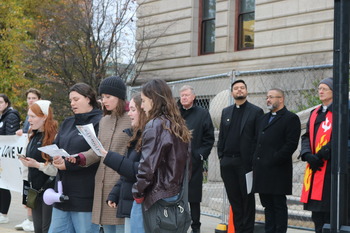
The next day, he encouraged those joining the “Interfaith Witness for Migrants and Refugees” that the Holy Cross Chaplain’s Office organized. The witness was inspired by this fall’s national One Church, One Family: Catholic Public Witness for Immigrants campaign, said Emily Rauer Davis, an associate director in the chaplains office. Holy Cross got Worcester Interfaith Network for Immigrant Support (WINIS) involved in inviting people to participate.
“One Church, One Family” was organized on the national level chiefly by the Ignatian Solidarity Network, with other Catholic organizations as partners helping local organizers with local events, explained media representative Andrew Hanson Quintana.
The campaign’s “second wave of prayer actions” was to be held Nov. 13, the feast of St. Frances Xavier Cabrini, patron of immigrants, according to a press release.
“Throughout October and November, Catholics held more than 120 events total,” it said. “Future events have not been determined but are likely to continue.”
The Nov. 7 event included Scripture readings and recounting of immigrants’ struggles. It began at Holy Cross, and continued with a procession to Worcester City Hall, where more than 100 people formed a “circle of silence.” Bishop McManus was among religious leaders praying or speaking there. Holy Cross students led singing. Participants included students from St. John’s High School in Shrewsbury.
Bishop Seitz’ lecture
Bishop Seitz’ Nov. 6 talk at Holy Cross, which drew about 100 people, was part of the college’s McFarland Center for Religion, Ethics and Culture lecture series called, “Catholic Resistance to Authoritarianism: Finding Moral Courage.”
The bishop said that last month he took to Pope Leo XIV letters from immigrants and showed him a video that the Hope Border Institute, a Catholic human rights organization at the U.S.-Mexico border, made from the letters.
This year the Institute received hundreds of letters, for him or the pope, from people around the United States, many of whom were undocumented or had undocumented family members, who were fearful because of U.S. immigration policies and practices, the bishop said.
Bishop Seitz showed listeners at Holy Cross the video, which is on the website . The video told of forced migration and deportation, and of immigrants’ faith moving them “to contribute to our family, our community and our world.” Immigrants expressed hope in God and asked the pope to proclaim that they are God’s children “and not disposable.”
They called for being, together, a Church of faith, justice and love.
Pope Leo “listened deeply” and watched the video with compassion, Bishop Seitz said.
The bishop noted that the Catholic Church in the United States has built institutions to support newcomers, resettled refugees and advocated for immigration reform and citizenship for the undocumented.
There is room for debate about how to best manage immigration, he said, and mentioned questions about work for those born here, connections between immigration and U.S. foreign policy and how to regularize long-term undocumented people.
Important questions have been off the table for some time, and one can blame either or both political parties, he said.
He spoke of a mass deportation campaign, without regard for immigrants’ contributions or whether they have permission to be here, and of parents and children separated.
The bishop quoted from Pope Leo’s address last month to participants in the World Meeting of Popular Movements: “States have the right and the duty to protect their borders, but this should be balanced by the moral obligation to provide refuge. With the abuse of vulnerable migrants, we are witnessing, not the legitimate exercise of national sovereignty, but rather grave crimes committed or tolerated by the state. Ever more inhumane measures are being adopted – even celebrated politically – that treat these ‘undesirables’ as if they were garbage and not human beings. Christianity, on the other hand, refers to the God who is love, who creates us and calls us to live as brothers and sisters.”
Bishop Seitz noted that his Holy Cross lecture was part of a series about authoritarianism, and spoke of some current examples of it in the U.S.
When the government abandons the wounded, the Church needs to be there, with love, solidarity, and commitment to justice and reform, speaking the truth, the bishop said.
Answering questions, he encouraged listeners to vote, and to seek more conscientious candidates.
“This should transcend Republican or Democrat,” he said. “Christians have to be disciples of Christ.”
The bishop called for reading, studying, acting, getting to know immigrants and telling stories that help others get to know them.
He told of a 4-year-old from Honduras with heart problems, who needed treatment in the United States. At that time several years ago, borders were shut but people in urgent need were supposed to be allowed into the U.S.
He and others decided to walk the girl and her family across the border. He was afraid for himself, but especially for them. He prayed, they started walking, the sick child’s 10-year-old sibling reached for his hand, and he felt better.
“That hand meant so much to me,” the bishop said. “It spurred me on.” (Eventually the family got across the border.)
Suggestions for parishes
Responding to questions from The Catholic Free Press about what local parishes should do, Bishop Seitz offered ideas.
Some parishes give presentations telling immigrants their rights, he said.
Parish leaders should have a plan for what to do if immigration officials come. They might display signs about what spaces are private.
Immigrants need to live their lives, not just stay home, he said. Parishes need to continue to serve them; “don’t take away the opportunity – that immigrant peoples need – to gather.” He suggested asking immigrants how they’re doing and what they need.
When thousands were crossing the border into El Paso “we opened our church halls,” and people brought meals and clothes, he said.
“We have one of the lowest economic levels in the country,” in the El Paso region, the bishop said. “And we discovered what we could do when we set our minds to it – and our hearts.”
Interfaith Witness
The Interfaith Witness Nov. 7 reiterated some of what Bishop Seitz said Nov. 6. He encouraged those bearing cold weather outside the college chapel to think about immigrants dropped off in an unfamiliar place, or living here and afraid to attend that gathering.
He asked participants if they were ready to walk, speak, pray, and work for justice for those who couldn’t be there, and received affirmative replies. He prayed for those present to be signs that faith is alive in Worcester and at Holy Cross and that what they do will help people live in peace and justice. Speaking in Spanish, he closed with the sign of the cross and talked about going forth in Christ’s peace.
City Hall gathering
Speaking in Spanish and English at City Hall, Father Jose F. Carvajal, head of school at St. Paul Diocesan Jr./Sr. High School, said he’s Colombian and expressed hope that each person be recognized, celebrated and loved.
Benjamin Kagigi, of Christian Community Church, said he’s from the Democratic Republic of the Congo, and he and his family were refugees in Kenya before coming to Worcester, where he helps African and Haitian immigrants.
“Lord, remind us that your love knows no borders,” he prayed.
Bishop McManus prayed, saying God desires justice for all, and asking him to enable us to uphold human rights and keep us faithful to all that is true.
Also represented were a rabbi, Muslims, a Unitarian and a representative of Worcester Friends Meeting (Quakers).
“Across our religious traditions, we find the sacred duty of hospitality woven into our teachings – to welcome the stranger, protect the foreigner, and honor the guest,” said Marty Kelly, an associate director in the Holy Cross Chaplains Office. “Our scriptures unite in proclaiming the inherent worth of every person. .. We are here ... to proclaim God’s vision for our world. ... We choose hope and unity over division and fear ...”