
Search
-
 December 12, 2025By Tanya Connor
The Catholic Free Press
WORCESTER – What do icons have to do with Advent? And how might creating them be part of prayer, priesthood, evangelization and aid to immigrants?
Just ask Father Donat Lamothe, a retired Augustinian of the Assumption, who, at age 90, works on icons almost daily.
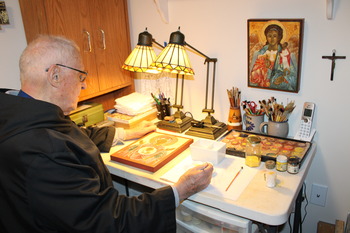
In his “prayer corner” at Emmanuel House at Assumption University are some of the 100-plus icons he estimates that he’s written. Iconographers talk about “writing” this form of sacred art because the icons depict Scriptural events and holy people in visual form, Father Lamothe explains.
When writing icons, artists are not absolutely free to do as they want, he says; they follow a longstanding Church tradition.
The icon in process on his desk – Mother of God of the Sign – depicts Mary with Jesus, older than a baby, visible in her womb.
“That’s the one that is often used during Advent, because the Child is coming from the Mother of God,” who is presenting him to the world, Father Lamothe says. “The Incarnation is represented here.” He recalls the prophecy, “Therefore the Lord himself will give you this sign: the virgin shall be with child, and bear a son, and shall name him Emmanuel” (Is 7:14).
“The whole of Advent tells us the story of how God becomes man,” Father Lamothe says. “An icon is trying to do the same thing. … If he became a human being, he can be visualized.” If the icon depicts a saint, it communicates the fact that the saint’s life “has been filled with the presence of Christ.”
“For me, writing an icon is a form of prayer,” Father Lamothe maintains. “As I’m writing it, I’m thinking of Christ or a saint” he’s depicting.
“Each of the steps has a spiritual content; there are 17 steps,” he says, and describes a few of them. “I blow on the mixture of clay and glue” after spreading it over the board on which the icon will be written, so gold leaf will adhere to it. “That becomes a way of putting the Divine on the icon,” reminiscent of God breathing on the waters and breathing life into man at creation.
Father Lamothe says breath and gold are the most important elements; “you put the gold on first because it is the divine color.”
Other symbolic colors – tempera (pigments mixed egg yolk and white wine) – are used, starting with a dark base coat, then adding highlights, then, with humility, partially covering one’s work with floats (glazes). The colors go from dark to light.
“Each time, the light becomes more obvious,” Father Lamothe comments. “That’s the whole principle of Christian life. We are going, especially during Advent, from dark to light. … You start with the darkness and you end up at Christmas.”
Icons make this and other spiritual realities visible. One way this is done is by stretching Christ’s halo beyond the dark green border which represents the limits of earth.
“The icon image comes through and enters into our world,” Father Lamothe explains. “Christ became man so that man could become like God.”
Icons, the priest notes, “come to us from the East” – Eastern Orthodox and Eastern Catholic Christians in Eastern Europe and the Middle East. “Recently the West has become more interested in the icons of the East.”
Father Lamothe says that in 1996 he looked for someone to teach him how to write icons, “I think because of my interest in the East, Eastern spirituality.
“The founder of the Assumptionists [Father Emmanuel d’Alzon] also had a great respect for the East”; he wanted Assumptionists and Oblates of the Assumption (a sister community he founded in 1865) to work towards bringing Eastern Orthodox and Roman Catholic Christians together.
Father Lamothe says his introduction to writing icons was a retreat/workshop given by Russian immigrant Vladislav Andreyev in 1996 on Enders Island in Connecticut. After that, he attended several of this iconographer’s workshops.
In about 2005, Father Lamothe decided he’d learned as much as he needed to. More specialized workshops would have required his absence from Assumption College (now Assumption University), where he ministered to students and had been teaching music since 1972, having started his career there as philosophy and theology teacher in 1963.
Now retired, he tries to write icons for an hour or two each day, Monday through Saturday, “because it’s part of my spiritual life.” He generally takes Sunday as a day of rest, even though “it’s not a labor; doing icons is a blessing to me, and, through me” to the people who receive them.
“At my age, it’s difficult to minister in the priesthood, so the icon becomes an extension of my priesthood,” a way to minister, he says.
What does he do with his icons?
“Some of them go into our communities,” he says. Some go to the Assumptionist Center in Brighton, where those interested can obtain one for an offering.
“You don’t sell sacred items,” Father Lamothe maintains. “The offering goes to our mission in El Paso. … That’s my way, as a 90-year-old, of participating in the work of my confreres” who are trying to serve immigrants at the U.S.-Mexico border.
He also sees icons as “a form of evangelization”; people can use them to pray or learn the theology behind them.