
Search
-
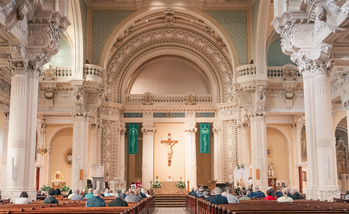 October 22, 2025On Oct. 19, Bishop McManus made his eighth pilgrimage to one of the Jubilee Year pilgrimage churches. Evening Vespers were held at 4 p.m.
VIEW THE PHOTO ALBUM
Notre Dame Church 446 Main St., Southbridge is open for tours during the 2025 Jubilee Year of Hope.
Hours:
Monday-Friday: Church open for self-guided tours from 7 a.m.-3 p.m.
Saturday – Church open for self-guided tours from 10 a.m.-5 p.m., confessions from 3-3:45 p.m. in English and Spanish, and Mass in English at 4 p.m. Church closes after Mass.
Sunday – Church open from 8 a.m.-5 p.m. with Masses at 8 a.m. and 10 a.m. in English and noon in Spanish. Guided tours available from 2-5 p.m.
Groups are to call the parish office at 508-765-3701 to arrange a visit.
Stamp available for “Jubilee 2025 Pilgrim’s Guide”
See the website stjp2parish.org/visit-notre-dame-church for more information.
Remembering the 1950 consecration of the Notre Dame Church
By Tanya Connor | The Catholic Free Press
The consecration of Notre Dame Church in Southbridge, on Oct. 11, 1950, involved rituals that still stand out in the mind of Marc A. LePain, who grew up there, teaches theology at Assumption University, and now lives in Groton.
Perhaps it’s no surprise that he remembers that day, which his father, Albert N. LePain, wrote about in “The History of Notre Dame Church, Southbridge, Massachusetts: A Marvel of Renaissance Art.” That 48-page book was published in 1991 in commemoration of the 75th anniversary of the church’s 1916 dedication.
The consecration had been mentioned briefly in a parish centennial book called “Notre Dame Church,” which Marc LePain said he himself wrote, but which doesn’t name an author. It was printed in 1969 after church renovations following the Second Vatican Council.
Albert LePain’s book said a consecration is to set a building apart “as a most fitting, permanent place of worship.”
Marc LePain said a church had to be debt-free to be consecrated. In 1916 Msgr. Louis O. Triganne, the pastor who oversaw the construction of Notre Dame, had announced that it cost $266,030.81 to build, and there was no debt.
“My dad took me to see parts of the ceremony” for the 1950 consecration which took about three and a half hours, said Marc LePain, who was seven years old at the time.
He remembered Bishop John J. Wright, first bishop of Worcester, processing around the outside of Notre Dame three times; each time the bishop blessed part of the church walls - the upper, lower and middle portions.
“He just [sprinkled] holy water as high as he could,” given the height of the church, Mr. LePain recalled.
Bishop Wright knocked on the church door with his crozier, traced a cross on the threshold and called for evil spirits to be dispersed, Albert LePain’s book said. The congregation, which was outside the church, watched.
The bishop entered the church, and sought the help of the Holy Spirit with the hymn, “Veni, Creator Spiritus,” and of the saints with the Litany of Saints.
Marc LePain described what happened next.
“Our parish sexton sprinkled ashes or dust up the center aisle in two lines” which formed an “X.” With the tip of his crozier, the bishop wrote the Greek alphabet in one line and the Latin alphabet in the other. Albert LePain’s book says the “X” symbolized Christ, the center of Christian doctrine.
Bishop Wright blessed water mixed with salt, ashes, and wine, to bless the interior walls and floor and use on the main altar.
The consecration of the altar, “one of the most solemn moments,” began with a procession, with relics of martyrs, to the altar, the book says. At this time, the congregation entered the church.
“After anointing the altar stone with Holy Chrism, the bishop sealed the relics in the altar with a specially blessed cement, including a Latin document attesting to the consecration,” Albert LePain wrote. The bishop censed the altar, blessed it with holy water and anointed it in different places.
Marc LePain’s memories come in here. Bishop Wright anointed 12 crosses around the walls, each of which had a candle with it, to be lit annually on the anniversary of the church’s consecration.
When overseeing the building of Notre Dame, Msgr. Triganne had ordered the architect to place Greek marble crosses, for a consecrated church, between the Stations of the Cross, behind the main altar and in the tower.
“He believed that some day this church would be consecrated like Notre Dame in Adams, Mass., where he had formerly been pastor,” Albert LePain wrote. Msgr. Jean-Baptiste Lamothe, pastor of Notre Dame in Southbridge when Bishop Wright consecrated it, had been a curate in Adams and master of ceremonies when that church was consecrated in 1908.
Timeline of Notre Dame and other Catholic churches in Southbridge
Compiled from parish and diocesan histories
1840: Father James Fitton from Worcester celebrates Mass in a house in Southbridge for Irish, German and French-Canadian Catholics.
1840s: Various priests celebrate Mass at different sites.
July 12, 1852: Construction of a church begins under Father John Boyce.
May 1, 1853: Bishop John B. Fitzpatrick of Boston dedicates St. Peter, Prince of the Apostles Church on Hamilton St.; various priests serve there.
Sept. 11, 1865: St. Mary of the Angels Parish is formed, with Father Angelus M. Baret as first resident pastor.
Nov. 29, 1869: Notre Dame Parish formed; Father Michael F. LeBreton, first pastor, celebrates its first Mass in Edwards Hall on Main St. Notre Dame serves French-Canadians; St. Mary’s serves the Irish and uses St. Peter’s Church.
Christmas 1870: The first Mass is celebrated in Notre Dame Church, Pine St.
1874: Notre Dame Church is dedicated.
1877: Bishop Patrick T. O’Reilly of Springfield lays the cornerstone for St. Mary of the Angels Church on Hamilton St.
1895: Msgr. Georges Elzear Brochu, Notre Dame’s second pastor, buys the Marcy estate, Marcy and Main streets, for a church, with the stipulation that Mr. Marcy may live there the rest of his life. (It is said Msgr. Brochu, encountering the aging man who was in no hurry to die, would ask, “How are you?” and Mr. Marcy would reply, “Very well, thank you.”) Msgr. Brochu dies first, in 1904.
Nov. 15, 1908: With 7,000-plus French-Canadian Catholics, Notre Dame is divided and Sacred Heart of Jesus Parish formed, with Father Emile St. Onge as its first pastor. Sacred Heart’s Masses are celebrated in an armory, then a school.
March 25, 1911: After Mr. Marcy’s death, ground is broken for Notre Dame Church.
July 2, 1916: Bishop Thomas D. Beaven of Springfield dedicates the new Notre Dame Church.
Sept. 11, 1916: Father A. A. Cyran, pastor of St. Joseph Parish, Webster, establishes an unnamed mission for Polish Catholics in Southbridge.
Jan. 1, 1918: St. Hedwig Parish is established for Polish Catholics, with Father Martin S. Hanyz as first pastor. Masses are held in the first Notre Dame Church.
1918: Father Hanyz buys land for St. Hedwig Church.
Sept. 6, 1920: Bishop Beaven dedicates St. Hedwig Church.
1926: Construction begins on Sacred Heart of Jesus Church.
1929: Bishop Beaven dedicates Sacred Heart of Jesus Church.
Oct. 11, 1950: Bishop John J. Wright, of the newly formed Worcester diocese, consecrates Notre Dame Church.
May 2010: Notre Dame and Sacred Heart of Jesus parishes are merged to form Notre Dame of the Sacred Heart Parish.
July 1, 2011: Notre Dame of the Sacred Heart is merged with St. Mary’s and St. Hedwig’s to form Blessed John Paul II Parish, using Notre Dame and St. Mary’s campuses.
April 2014: The parish name is changed to St. John Paul II with the canonization of its patron.