
Search
-
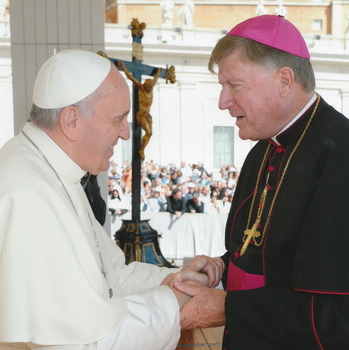 April 21, 2025By Tanya Connor and Maria Young
The Catholic Free Press
Bishop McManus offered his prayers in union with Catholics around the world Monday “that God welcome [Pope Francis] into eternal life.”
“We are all saddened to hear of the death of our Holy Father on this Easter Monday,” Bishop McManus said in a public statement.
Pope Francis died at 7:35 a.m. Rome time Monday morning, the Vatican announced around two hours later.
“For 12 years as our Holy Father, Pope Francis consistently preached to the world that one of the key tenets of being a follower of Jesus Christ is to accompany others who seek God’s love,” Bishop McManus wrote.
He told The Catholic Free Press that he was “taken aback” when he learned of the pontiff’s death early Monday morning when he returned a friend’s Easter greeting.
“He had made so many strides coming back from the hospital,” Bishop McManus said, adding that if his 12-year pontificate showed us anything, it was that Pope Francis had “a will of steel.”
A true pastor, Pope Francis “got pastorally restless and wanted to be with his people,” he said, acknowledging that the pope made a few surprise public appearances during his convalescence following a more than five-week hospital stay at Rome’s Gemelli hospital Feb. 14 through March 23.
“I call it a divine irony that he would die on Easter Monday. It is remarkable.”
A dozen priests, including Bishop-elect Richard F. Reidy; a couple permanent deacons and nearly 200 people of different ages and ethnic groups joined Bishop McManus at the 12:10 p.m. weekday Mass at St. Paul Cathedral Monday which he celebrated for Pope Francis.
“There’s only one thing you can do when you hear the pope died – go to church,” said Felipe Fernandez del Castillo, who attended the Mass with his wife, Lisa, and their children – Theresa, 9; Peter, 6; Anna, 2; and Caroline, 2 months. The family is part of St. John, Guardian of Our Lady Parish in Clinton.
Mr. Fernandez del Castillo said his brother, Juan Pablo Fernandez del Castillo, of St. Paul Parish in Cambridge, who was visiting Rome, had seen the pope the day before – on Easter – looking ill but riding in the popemobile. He texted the family on WhatsApp after learning of the pope’s death.
The couple had learned of Pope Francis’ election on a car radio when they were engaged.
“Who’s this guy?” Mrs. Fernandez del Castillo recalled thinking. “What do we know about him?”
Some years later she’d be asking her children what they knew.
“I remember Mom asking Peter, asking both of us, if we knew who the Holy Father was,” said Theresa, her oldest. “Peter thought it was God. I knew it was the pope.”
Bishop McManus preached about the pope at Monday’s Mass. For the last 12 years, Pope Francis “was the premier witness” to the world of Jesus’ resurrection, he said. The pope proclaimed that the One who was dead is alive – he lives among us.
The bishop read the statement he himself issued Monday morning.
He highlighted special attributes of Pope Francis, including his preaching about accompanying others who seek God’s love and his pastoral focus.
“The beauty of the Catholic faith is like a multifaceted diamond. Each pope brings a focus on one of the facets through which we can deepen our appreciation of our faith and the mission to which we are called. His focus was on the pastoral facet, best understood when we hear his name in Spanish: Papa Francisco,” Bishop McManus stated.
“He taught us all to accompany our brothers and sisters, whether in the mainstream or on the periphery of society, so that they may experience God’s love through our own love for them.”
It is fitting to commend the pope to God during this Jubilee Year of Hope, Bishop McManus said. “Perhaps his greatest legacy is that, as the Vicar of Christ, he focused this Jubilee Year on the reality that the death and resurrection of Jesus Christ, which we just celebrated this Easter, is the key to hope for eternal life in the loving presence of God. May he now rest in the peace of God’s love. Amen.”
The bishop’s voice broke as he led the congregation in praying that God grant Pope Francis eternal rest. Following were the Prayers of the Faithful, some of them specifically for Pope Francis.
“He did what he was asked to do by the Lord,” Gerry Levins, of St. Anne Parish in Southborough, said of the pope, whose death he learned of in an email from his pastor, Father Albert Irudayasamy, a concelebrant at the Mass.
“I believe [Pope Francis] brought back wayward Catholics, like myself,” Mr. Levins continued. He was Catholic for 50 years, Protestant for four or five years, and returned to the Catholic Church more than five years ago “under this pope,” he said. “God gets credit; the pope gets credit.” While Pope Francis wasn’t the only inspiration for his return to the Church, he highlighted the pope’s focus on what Jesus said (in Matthew 25) brings one to eternal life – care for the poor, sick, prisoners etc. – and that it is our job to reach out.
“He was an amazing person,” Joseph Reilly, of St. Paul Cathedral, said of Pope Francis. “You can only hope that the next pontiff can match what he did.”
What does the universal Church need most in the next pope?
Bishop McManus told The Catholic Free Press that with “any pope, his major ministry is to be pastor of the universal Church, and obviously, it is a huge Church. So, he has to present himself as a source of unity. ... A beautiful phrase given to the bishop of Rome is that he ‘presides over the whole church in love.’”
The next pope, any pope, has to be holy, well-educated and know many languages, he said.
He said that one of the challenges of the conclave, tasked with the duty of electing Pope Francis’ successor, will be that “the cardinals do not know each other.”
Pope Francis “talked about going to the peripheries whether geographically or spiritually. So, he appointed cardinals [in the peripheries],” Bishop McManus said, giving the example of Mongolia which according to Vatican News had around 1,500 Catholics as of 2023.
“I think we are really going to have to pray for guidance to the Holy Spirit for the good of the Church. The good of the Church has to weigh more heavily than political-theological points of view.”